I. Development of China's Trade-In Policy
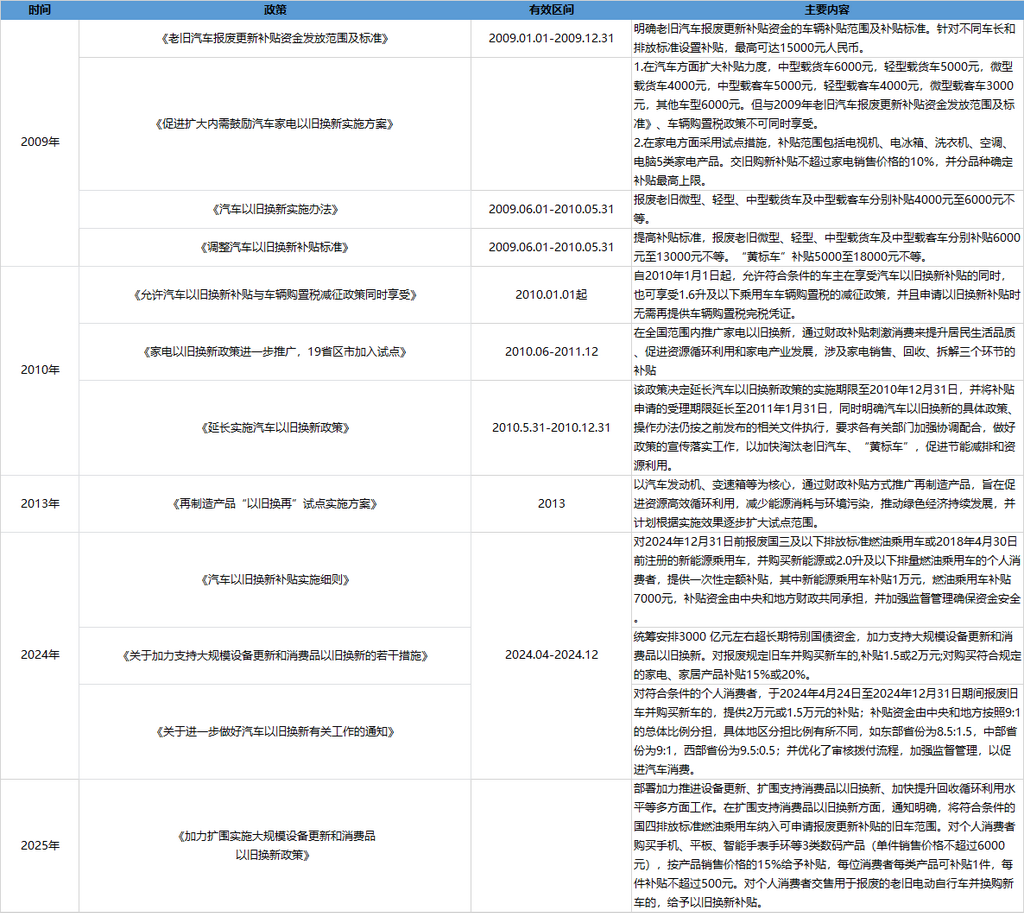
China's trade-in policy has a long history. With economic development and the growing awareness of environmental protection, the scope of the trade-in policy has gradually expanded to include household appliances, automobiles, electronic products, furniture, and many other areas.
In 2009, the government provided financial subsidies for the trade-in of household appliances and automobiles, encouraging consumers to replace high-energy-consuming old cars and appliances. This policy stimulated domestic demand and promoted steady economic growth. By 2024, the government advanced a new wave of trade-in policy initiatives aimed at stimulating consumption vitality, boosting investment growth, promoting industrial upgrading, and supporting green transformation. On January 8, 2025, the National Development and Reform Commission (NDRC) and the Ministry of Finance issued a notice on the intensified and expanded implementation of large-scale equipment renewal and consumer goods trade-in policy for 2025, further outlining efforts to accelerate equipment renewal, expand support for consumer goods trade-in, and enhance recycling and reuse levels.
II. Evaluation of China's Trade-In Policy
China's trade-in policy is a comprehensive and far-reaching initiative. Since its implementation, the policy has achieved remarkable results in multiple areas. It has significantly contributed to both economic and ecological benefits. From an economic perspective, the policy has effectively stimulated domestic consumption demand, particularly in the automotive and household appliance sectors, where sales have increased significantly. Against the backdrop of substantial downward pressure on the economy, the trade-in policy has spurred consumer purchasing enthusiasm through financial subsidies and preferential policies, thereby boosting the growth of related industries. It has also provided an opportunity for the transformation and upgrading of the manufacturing sector, compelling enterprises to increase R&D investment and launch more environmentally friendly new products.
From an ecological perspective, the trade-in policy has significantly reduced the use of high-energy-consuming products and lowered greenhouse gas emissions. By encouraging consumers to replace old products with new energy-efficient ones, the policy has helped reduce environmental pollution and resource waste, promoting sustainable development in society. Therefore, the implementation of this policy not only aligns with the country's low-carbon economic strategy but has also earned international acclaim.
Finally, the trade-in policy has accelerated the elimination and renewal of outdated equipment, creating favorable conditions for the promotion of new technologies and products, thereby facilitating industrial upgrading and structural adjustment.
However, the implementation of the trade-in policy also faces challenges, such as financial subsidies potentially leading to market overheating and irrational consumption. Additionally, the disposal of replaced old products remains an urgent issue to address. Nevertheless, overall, China's trade-in policy has been successful and offers valuable insights for other countries.
III. Predictions for the Future Development of China's Trade-In Policy
In recent years, China's trade-in policy has become an important tool for promoting consumption, boosting investment, and advancing green transformation. Based on current conditions and future trends, it is expected that China's trade-in policy will undergo adjustments and optimizations in the following areas.
First, China's trade-in policy is expected to continue deepening and expanding its scope to cover more product categories. While it currently focuses on household appliances and automobiles, it may extend to include items such as smart home appliances, energy-saving lighting, green food, and 3C digital products. Additionally, the allocation of funds and subsidy application processes will likely be further optimized to ensure that benefits reach consumers conveniently. With the development of artificial intelligence and the Internet of Things, the trade-in policy may integrate with smart home and smart city initiatives, forming a more comprehensive green consumption ecosystem.
Second, the implementation methods of the trade-in policy will become more diverse and refined. In the future, financial subsidies may continue, but other tools such as tax reductions and financial credit support could also be employed. The government may also place greater emphasis on guiding and encouraging enterprises and social capital to participate, creating a win-win situation for the government, businesses, and consumers.
Finally, the environmental attributes of the trade-in policy will become more prominent. Based on China's environmental commitments in international climate change negotiations, future policies will place greater emphasis on the recycling and reuse of old products, ensuring minimal environmental impact throughout the entire life cycle of products, from production to scrap. This approach not only aligns with the country's sustainable development strategy but also achieves an organic integration of economic, social, and environmental benefits. In the future, as China's comprehensive national strength grows and global environmental pressures increase, China's trade-in policy will continue to play a significant role in promoting global green development.
SMM New Energy Industry Research Department
Cong Wang 021-51666838
Xiaodan Yu 021-20707870
Rui Ma 021-51595780
Ying Xu 021-51666707
Disheng Feng 021-51666714
Yujun Liu 021-20707895
Yanlin Lü 021-20707875
Ye Yuan 021-51595792
Chensi Lin 021-51666836
Zhicheng Zhou 021-51666711
Haohan Zhang 021-51666752
Zihan Wang 021-51666914
Xiaoxuan Ren 021-20707866
Yushuo Liang 021-20707892
Jie Wang 021-51595902
Yang Xu 021-51666760
![Cobalt Products Prices Show Mixed Performance, Refined Cobalt Rose 2,000 Yuan in a Single Week, Cobalt Salt Market Awaits Demand Recovery [Weekly Review]](https://imgqn.smm.cn/usercenter/Bwmed20251217171726.jpg)